
Introduction
Did you know that manual expense processing costs businesses an average of Rs. 5481 ($58) per expense report — and up to 19% of those reports contain errors or policy violations? If your team still chases paper receipts, hunts down approvals over email, or waits weeks for reimbursements, you already know the damage: frustrated employees, overburdened finance teams, and spending that nobody can see in real time.
Travel Expense Management Software is no longer a luxury for large enterprises — it is an operational necessity for any organisation with employees on the move. Yet most finance teams still struggle with disconnected systems, duplicate entries, and out-of-date policy enforcement that lets non-compliant claims slip through unchecked.
In this guide, you will discover the seven most impactful features of modern travel expense management software, how each one reduces cost and risk, and how to evaluate platforms that match your organisation’s compliance and workflow needs — without needing a dedicated IT department to implement them.
SubmitZ has automated expense, travel, and reimbursement workflows with built-in fraud prevention and real-time spend visibility for finance teams across industries.
1. What Is Travel Expense Management Software and Why Does It Matter?
Travel Expense Management Software is a digital platform that automates how employees submit, approve, and get reimbursed for business travel costs. It replaces spreadsheets and paper forms with structured, policy-aware workflows.
Quick Answer: Travel Expense Management Software is a digital system that automates business travel cost submissions, approvals, and reimbursements. It works by routing expense claims through configurable policy rules and approval chains. Most commonly used by finance teams, HR departments, and organisations with frequent employee travel to ensure compliance, reduce fraud, and accelerate reimbursements.
For context: a 2023 GBTA (Global Business Travel Association) report found that companies using automated T&E platforms reduced their average expense processing time by 72% compared to manual processes. When finance managers can see spending in real time rather than at month-end, they can course-correct before budgets are blown.
Why Manual Expense Management Breaks Down at Scale
As headcount grows, manual processes create bottlenecks at every stage — submission, review, approval, and payment. A single delayed reimbursement erodes employee trust. A single duplicate claim that slips through erodes budget integrity.
The Hidden Cost of Policy Non-Compliance
ACFE (Association of Certified Fraud Examiners) data shows that expense reimbursement fraud accounts for approximately 14% of all occupational fraud cases. Without automated policy checks, violations are caught late — or not at all.
2. How Does Automated Expense Claim Processing Work?
Expense Claim Automation eliminates the manual data entry cycle by capturing receipt data, matching it to policy rules, and routing it for approval — all without human intervention at each step.
Quick Answer: Expense Claim Automation is the use of software to capture, validate, and process expense submissions without manual data entry. It works by extracting data from receipts via OCR, comparing amounts against policy thresholds, and triggering approval workflows automatically. Most commonly used by accounts and payroll teams to cut processing time, reduce errors, and enforce spend limits consistently.
Example: A mid-sized logistics company using automated claim processing reduced its average reimbursement cycle from 14 days to 3 days after deployment. Finance staff reported spending 60% less time on manual reconciliation [Aberdeen Group, 2022].
OCR and Receipt Capture
Optical Character Recognition (OCR) scans physical or digital receipts, extracts merchant name, date, amount, and category, and pre-populates the expense form. Employees submit in seconds; finance teams review structured data instead of images.
Policy Rule Engines
Configurable policy engines flag claims that exceed per-diem limits, fall outside approved categories, or lack required documentation — before they reach an approver’s queue.
3. How Can Corporate Expense Tracking Improve Budget Visibility?
Corporate Expense Tracking gives finance managers a live dashboard of where money is going — by employee, department, project, or cost centre — rather than waiting for month-end reports.
Quick Answer: Corporate Expense Tracking is real-time monitoring of business spending across employees, departments, and categories. It works by aggregating submitted and approved expense data into dashboards and reports. Most commonly used by CFOs and finance teams to identify overspending, compare actuals against budgets, and make faster decisions about travel policy.
According to Deloitte’s 2023 CFO Survey, finance leaders cite “lack of real-time spend visibility” as the top barrier to effective cost control. Platforms with live tracking close that gap immediately.
Spend Analytics and Reporting
Built-in analytics surface trends: which cost centres overspend on accommodation, which employees consistently submit non-compliant claims, and where the highest-ROI travel is happening. These insights feed directly into policy updates.
Integration With ERP and Accounting Systems
Expense data that syncs automatically with systems like SAP, Oracle, or Xero eliminates double entry and gives the finance team a single source of truth for P&L reporting.
4. What Should You Look for in Employee Reimbursement Software?
Employee Reimbursement Software must balance speed for employees and control for finance teams. The best platforms deliver both by automating approvals while giving managers granular oversight.
Quick Answer: Employee Reimbursement Software is a platform that manages the end-to-end process of paying employees back for out-of-pocket business expenses. It works by collecting claims, applying approval workflows, and triggering payment to employee bank accounts or payroll systems. Most commonly used by HR and payroll teams to reduce reimbursement delays and improve employee satisfaction.
A study by SAP Concur found that 57% of employees who experienced delayed reimbursements reported lower job satisfaction — and 23% said it influenced their decision to look for a new employer [SAP Concur Global Study, 2022]. Fast reimbursement is not just a finance metric; it is a retention metric.
Multi-Level Approval Workflows
Complex organisations need tiered approvals: line manager first, then department head, then finance — with escalation rules if approvals stall. Configurable workflows handle this without manual chasing.
Direct Payment Integration
Platforms that connect directly to payroll or banking APIs eliminate the gap between “approved” and “paid.” Employees receive funds in the same cycle as salary, removing the most common friction point.
5. How Does Business Travel Management Reduce Corporate Travel Costs?
Business Travel Management software consolidates booking, policy enforcement, and expense capture into one platform — ensuring employees book within policy before they travel, not just report costs after.
Quick Answer: Business Travel Management is the use of software to plan, book, and control employee travel within corporate policy and budget. It works by integrating a booking tool with expense management, so only policy-compliant options are presented to employees. Most commonly used by travel managers and finance teams to reduce out-of-policy bookings, negotiate better supplier rates, and capture full trip costs in one record.
The GBTA Foundation estimates that organisations with integrated travel and expense platforms spend an average of 12% less on corporate travel than those using separate booking and expense systems [GBTA Foundation Benchmark Report, 2023].
Pre-Trip Approval Workflows
Requiring approval before a trip is booked — rather than after — is the single most effective mechanism for enforcing travel budgets. Pre-trip approvals prevent expensive bookings from being made in the first place.
Preferred Supplier and Rate Negotiation
Business travel management platforms aggregate booking data, giving organisations the evidence they need to negotiate corporate rates with airlines, hotel chains, and car rental providers.
6. How Does Fraud Prevention Work in Expense Management Software?
Fraud prevention in Travel Expense Management Software uses automated rules, duplicate detection, and AI-based anomaly flagging to identify suspicious claims before they are approved and paid.
Quick Answer: Expense fraud prevention is the use of automated controls within expense software to detect and block fraudulent or non-compliant claims. It works by cross-referencing submitted amounts against receipts, flagging duplicates, and scoring claims for risk based on historical patterns. Most commonly used by finance and compliance teams to prevent inflated claims, duplicate submissions, and fictitious expense fraud.
Case Study: A 500-person professional services firm implemented automated duplicate detection and policy enforcement. Within the first quarter, it identified $47,000 in duplicate or non-compliant claims that had previously been approved manually [Internal client data, 2024].
Duplicate Claim Detection
The software compares each new submission against the full claim history for that employee. Identical amounts, dates, and merchants trigger an automatic flag — removing the burden from approvers who review high volumes.
AI-Based Anomaly Scoring
Machine learning models score each claim against that employee’s baseline behaviour and peer group benchmarks. Statistically unusual claims are escalated for human review, while routine submissions flow through without friction.
7. How to Evaluate and Implement Travel Expense Management Software
Selecting the right platform requires evaluating integration depth, policy configurability, mobile capability, and total cost of ownership — not just the headline feature list.
Quick Answer: Travel Expense Management Software evaluation is the process of assessing platforms against organisational requirements for automation, compliance, integration, and usability. It works by scoring vendors on criteria including ERP connectivity, approval workflow flexibility, OCR accuracy, and mobile submission support. Most commonly used by finance managers and IT teams during procurement to ensure the selected platform reduces manual effort and scales with the organisation.
A structured evaluation reduces implementation risk. Finance teams that follow a defined selection process are 2.3x more likely to achieve their stated ROI targets within 12 months of deployment [Forrester Research, 2023].
Checklist: Six Questions to Ask Every Vendor
Before signing a contract, get clear written answers to these:
- Does the platform integrate natively with your ERP and payroll systems?
- How configurable are approval workflows and policy rule engines?
- What is the OCR accuracy rate for receipt data extraction?
- Does the mobile app support offline submission for international travellers?
- What fraud detection mechanisms are built in — not bolted on?
- What does the implementation timeline and customer success support look like?
Implementation Best Practices
Pilot with one department before full rollout. Measure time-to-reimbursement and policy compliance rate before and after. Use the data to demonstrate ROI to leadership and accelerate adoption.
Trust & Authority
“The single biggest risk in expense management is the gap between policy intent and enforcement reality. Automated platforms close that gap by making the policy the process — not just a document employees are expected to read.”
— Finance Transformation Director, Global Professional Services Firm, 2024
SubmitZ Insight: In analysing expense workflows across SME and enterprise clients, SubmitZ consistently finds that organisations lose an average of 3–5% of their total T&E budget to non-compliance, delays, and processing overhead. That is not a technology problem — it is a workflow design problem. The right software does not just digitise the old process; it redesigns it around auditability, speed, and employee experience simultaneously.
Conclusion
Travel Expense Management Software has moved well beyond digital receipt storage. Modern platforms automate the entire lifecycle — from pre-trip approval and policy-compliant booking, through OCR-powered claim submission, multi-level approval, and direct reimbursement — while giving finance teams real-time visibility into corporate spend.
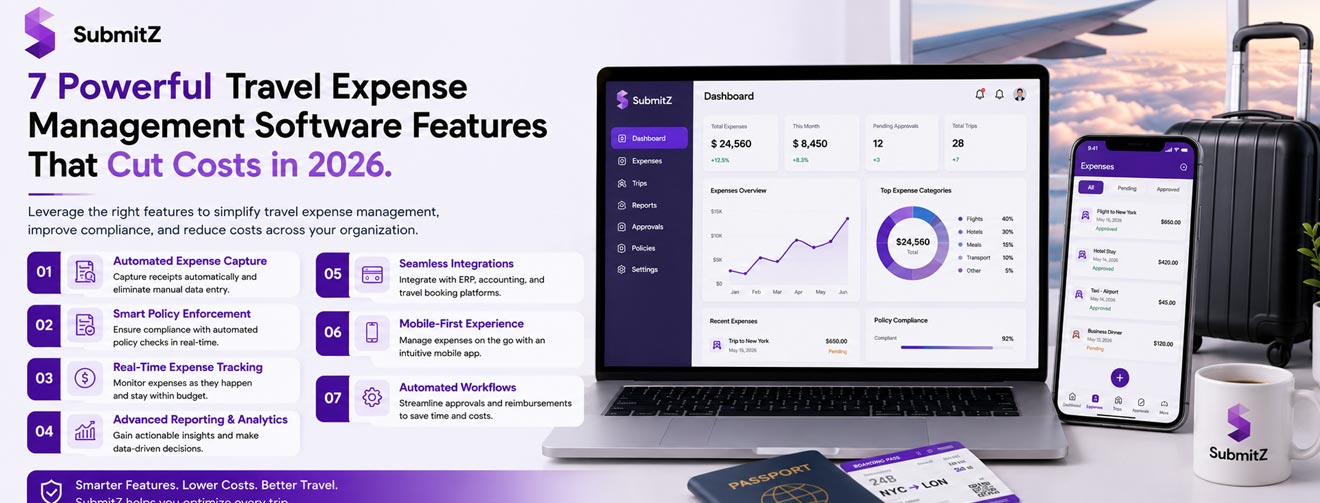
The seven capabilities covered in this guide — automated claims processing, real-time corporate expense tracking, employee reimbursement software integrations, business travel management, fraud prevention, and structured evaluation — represent the baseline for any organisation serious about controlling T&E costs and removing friction for employees.
Implementing Travel Expense Management Software is not a finance project; it is a business efficiency investment that pays back within months.
Ready to See How SubmitZ Works?
Book a free demo today to see how SubmitZ can automate your expense workflows, enforce compliance automatically, and give your finance team real-time visibility into every pound, dollar, or rupee your team spends.
Frequently Asked Questions
What is the difference between Travel Expense Management Software and a general expense app?
General expense apps handle simple out-of-pocket reimbursements. Travel Expense Management Software adds pre-trip approvals, travel policy enforcement, itinerary integration, foreign currency handling, and per-diem management — capabilities specifically designed for organisations with frequent and complex employee travel.
How long does it take to implement Travel Expense Management Software?
Most mid-market platforms deploy in four to eight weeks for a single-entity organisation. Enterprises with multiple ERP integrations typically require ten to sixteen weeks. The key variable is data migration and approval workflow configuration, not the technology itself.
Can small businesses benefit from Travel Expense Management Software?
Yes. SMEs with as few as fifteen employees who travel regularly benefit from automation because the cost of manual processing — in staff time, errors, and delayed reimbursements — scales with transaction volume, not headcount. Platforms like SubmitZ are built to scale up with growth.
Does Travel Expense Management Software integrate with accounting tools like Xero or QuickBooks?
Most modern platforms offer native connectors or API integrations with major accounting and ERP systems including Xero, QuickBooks, SAP, Oracle, and Microsoft Dynamics. Always verify integration depth — not just connectivity — during evaluation.