
Get in Touch
-
Phone
+91 93115 81081
-
Email Now
hi@submitz.com
-
Delhi, India
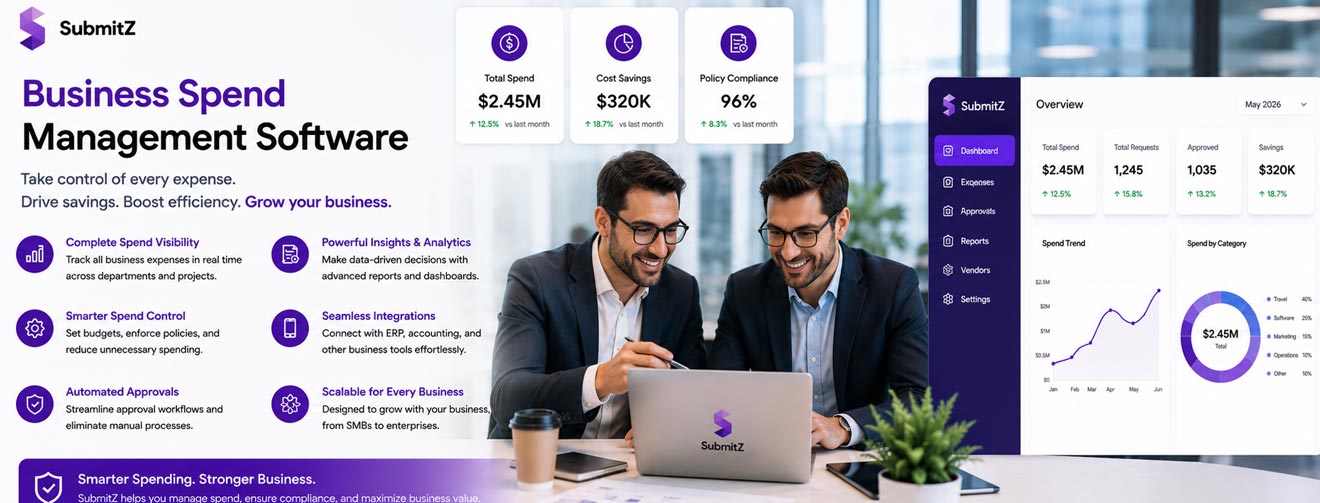
Business spend management (BSM) software is a unified platform that tracks, controls, and analyzes every dollar a company spends — from employee expenses and travel to vendor payments and procurement — in one connected system instead of scattered spreadsheets and disconnected tools. It matters because untracked, fragmented spending leads to budget overruns, policy violations, and poor financial visibility. Modern platforms like SubmitZ bring real-time spend tracking, automated policy enforcement, and clear reporting together, helping finance teams control costs without slowing the business down.
Business spending rarely happens in one place. Employees book travel and submit expense claims. Departments subscribe to software tools. Procurement teams negotiate vendor contracts. Finance processes invoices and approves payments. Each of these activities represents money leaving the business — and in most companies, each one runs through a different tool, a different approval chain, or no formal process at all.
The result is a fragmented picture of spend that makes it difficult to answer basic questions: How much are we really spending on travel this quarter? Are we paying for software subscriptions nobody uses? Is spending staying within budget across departments? Without a unified view, these questions get answered too late — usually after the money is already gone.
This is the problem business spend management software is built to solve. In this guide, we'll cover what BSM software actually does, the pain points it addresses, what to look for in a platform, and how SubmitZ fits into a modern spend management approach.
Business spend management software is a category of tools that unifies the tracking, control, and analysis of company-wide spending across multiple categories, including:
It's important to note that spend management is broader than expense management alone. Expense management typically handles employee reimbursements reactively, after the spending has already happened. Spend management is the proactive layer above it — covering budgets, vendor oversight, and policy enforcement across the entire business, not just what employees submit for reimbursement.
When spending data lives across disconnected systems and spreadsheets, finance teams can't get a clear, current picture of where money is going. This makes it difficult to monitor budgets, detect anomalies, or catch uncontrolled spending before it becomes a problem.
Without centralized oversight, employees and departments can make purchases outside approved vendors or budgets — often unintentionally — leading to inconsistent pricing, missed volume discounts, and spend that's hard to trace back to a business purpose.
Manual data entry across procurement, invoicing, and expense reporting leads to duplicate payments, misclassified expenses, and lost receipts. These errors compound over time, making financial reporting less reliable and audits more painful.
In many companies, policy violations are only caught after the money has already moved — during a manual review or, worse, during an audit. By then, correcting the spend is no longer possible; all that's left is documenting the exception.
When purchase requests, invoice approvals, and payment authorizations are routed through email or informal handoffs, bottlenecks form. This delays vendor payments, frustrates employees waiting on approvals, and adds unnecessary manual work for finance teams.
Subscriptions and vendor contracts often go unreviewed for years. Without a system to track and flag recurring spend, businesses commonly end up paying for duplicate software licenses, unused vendor contracts, or services no longer needed — a quiet but significant drain on the budget.
When spend data isn't centralized or timely, finance leaders are forced to forecast based on incomplete or outdated information, making it harder to plan budgets accurately or respond quickly to changing business conditions.
When evaluating a platform, businesses should prioritize:
SubmitZ is built around a simple principle: every dollar a business spends should be visible, trackable, and easy to manage — without adding administrative burden to employees or finance teams. Here's how SubmitZ addresses the pain points above:
SubmitZ brings expense and travel spend data into a single, real-time dashboard, giving finance teams a clear, current view of company-wide spending instead of piecing together numbers from multiple sources.
Spending policies are enforced at the point of submission, flagging out-of-policy expenses immediately rather than relying on manual review after the fact — helping prevent maverick spending before it happens.
Configurable, automated approval workflows route requests to the right approver instantly, reducing the delays that come from email-based or informal approval chains.
By automating receipt capture, categorization, and reconciliation, SubmitZ reduces the manual data entry that leads to duplicate payments, misclassified expenses, and lost documentation.
With accurate, real-time spend data, finance teams can identify overspending patterns, evaluate vendor and category trends, and make informed budget decisions rather than relying on outdated or incomplete reports.
As a business grows in headcount and spend complexity, SubmitZ's configurable policies and workflows scale alongside it, helping maintain visibility and compliance without requiring a platform switch down the line.
Companies don't have to choose between growth and financial discipline. Businesses that gain clear, real-time visibility into their spending are better positioned to identify waste, negotiate stronger vendor terms, and reinvest savings into the areas that actually drive growth. As spending complexity increases with headcount, geography, and vendor relationships, the businesses that manage spend proactively — rather than reactively reconciling it after the fact — build a lasting operational advantage.
Business spend management software isn't just a finance tool. It's the operational layer that keeps growth, cost discipline, and financial accuracy working together, rather than working against each other.
Expense management typically covers employee reimbursements handled after the spending has occurred. Spend management is broader, covering budgets, procurement, vendor payments, and policy enforcement across the entire business, including but not limited to employee expenses.
Spreadsheets don't provide real-time visibility, automated policy enforcement, or integration with accounting systems, making them difficult to scale as spending volume and organizational complexity grow.
By centralizing spend data and providing real-time analytics, platforms like SubmitZ help identify wasteful or redundant spending, enforce budget compliance automatically, and support better-informed vendor and budget decisions.
No. While large enterprises need spend management software to handle scale and complexity, growing businesses of any size benefit from earlier visibility and control over spending before inefficiencies become harder to fix.
Yes. Most modern platforms, including SubmitZ, are designed to integrate with common accounting and ERP systems, allowing spend data to flow directly into financial reporting without manual data entry.
Ready to bring every dollar your business spends into one clear, connected system? See how SubmitZ can help your finance team gain real-time visibility, enforce policy automatically, and take control of company-wide spend.