
Get in Touch
-
Phone
+91 93115 81081
-
Email Now
hi@submitz.com
-
Delhi, India
Small and Medium Enterprises (SMEs) are the backbone of every economy. As businesses grow, managing employee expenses, travel claims, reimbursements, vendor payments, and financial approvals becomes increasingly complex.
Many SMEs still rely on spreadsheets, paper receipts, email approvals, and manual accounting. While this may work for very small teams, it quickly leads to:
This is where Expense Management Software for SMEs becomes an essential business tool.
Modern expense management software automates the complete expense lifecycle—from receipt capture to reimbursement—helping finance teams save time, reduce costs, and gain complete visibility into company spending. Industry-leading platforms increasingly automate receipt capture, policy enforcement, approval workflows, accounting integrations, and analytics, reducing manual work while improving compliance.
Expense Management Software is a digital solution that helps businesses record, approve, monitor, reimburse, and analyze employee expenses through a centralized platform.
Instead of manually processing receipts and invoices, employees submit expenses digitally while managers approve them online.
Finance teams receive clean, organized expense data that integrates directly into accounting systems.
Growing businesses face unique financial challenges.
Unlike large enterprises, SMEs often have:
Without automation, finance teams spend valuable hours processing paperwork instead of focusing on strategic financial planning.
Expense management software removes these bottlenecks.
Employees frequently lose receipts during business travel.
Missing documentation delays reimbursements and creates accounting issues.
Expense claims often travel through multiple emails before receiving approval.
This wastes valuable management time.
Finance teams repeatedly enter the same information into spreadsheets and accounting software.
Manual entry increases errors.
Without centralized tracking, duplicate reimbursement requests can go unnoticed.
Business owners often don't know:
until it's too late.
Improper documentation creates tax filing challenges and audit risks.
Employees submit expenses through a web portal or mobile app instead of filling out spreadsheets.
Approved claims move directly to finance, reducing reimbursement delays.
Employees appreciate faster payments.
Real-time dashboards help business owners understand:
Expense policies are automatically enforced.
Claims exceeding company limits can be flagged before approval, helping finance teams reduce policy violations and improve consistency.
Automated validation helps detect:
Automation significantly reduces administrative work.
Finance teams can focus on budgeting and business growth instead of paperwork.
Choosing the right software requires understanding which features provide the greatest business value.
Employees should be able to:
Optical Character Recognition (OCR) automatically reads:
This eliminates manual typing.
Businesses often require:
Automation streamlines the process.
For companies with traveling employees, software should manage:
Employees should be able to check:
from one dashboard.
Every organization has reimbursement rules.
Good software automatically checks:
before processing expenses.
Decision-makers need reports showing:
Expense software should integrate with accounting systems to avoid duplicate data entry and speed reconciliation.
Many SMEs view software as an expense.
In reality, it is an investment.
Savings come from:
Over time, these efficiencies often deliver a strong return on investment.
Expense management software is valuable across many sectors, including:
While spreadsheets are familiar, they introduce several limitations:
| Spreadsheet | Expense Management Software |
|---|---|
| Manual entry | Automated data capture |
| Paper receipts | Digital receipts |
| Email approvals | Workflow automation |
| Limited reporting | Real-time dashboards |
| Higher error rates | Built-in validation |
| Difficult audits | Centralized audit trail |
| No mobile support | Mobile access |
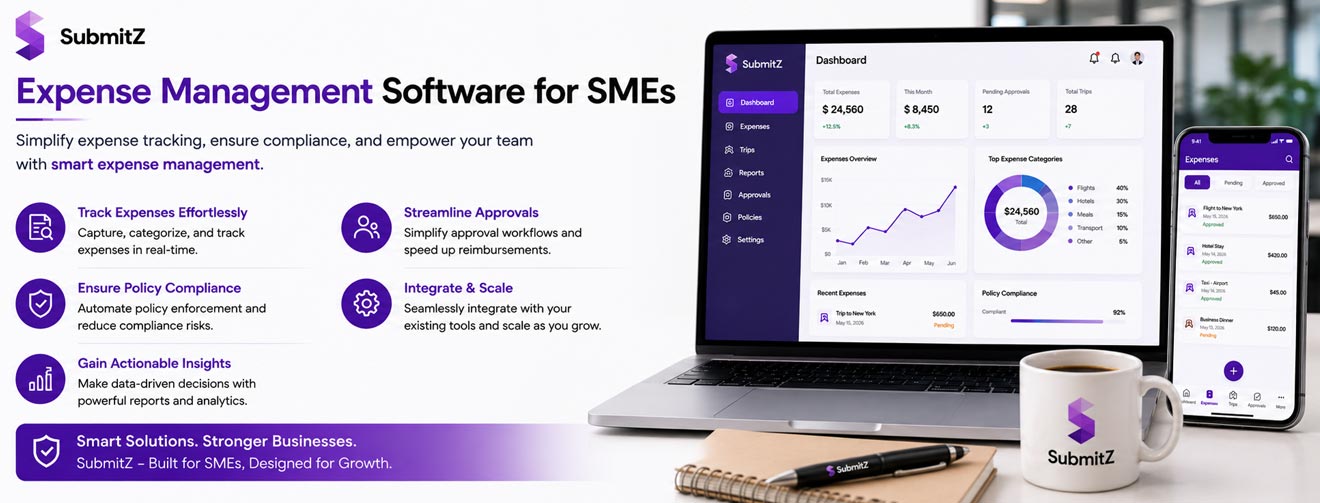
SubmitZ is designed to help growing businesses modernize how they manage employee expenses, travel, reimbursements, approvals, and financial workflows.
Key capabilities include:
These capabilities align with the broader direction of modern expense management platforms, which emphasize automation, policy compliance, integrations, and actionable reporting.
Before selecting a solution, consider:
Expense management continues to evolve with technologies such as:
These innovations help SMEs improve accuracy, compliance, and financial decision-making.
For SMEs, every rupee—and every minute—counts. Manual expense processes create unnecessary delays, increase administrative effort, and make it harder to control costs.
Implementing modern expense management software enables businesses to automate approvals, streamline reimbursements, improve compliance, and gain real-time visibility into spending. As your business grows, a centralized expense management solution becomes an important foundation for efficient financial operations.
If you're looking to modernize your expense processes, SubmitZ offers a streamlined platform to help SMEs manage expenses, travel, approvals, and reimbursements more effectively while giving finance teams greater control and insight.