
Get in Touch
-
Phone
+91 93115 81081
-
Email Now
hi@submitz.com
-
Delhi, India
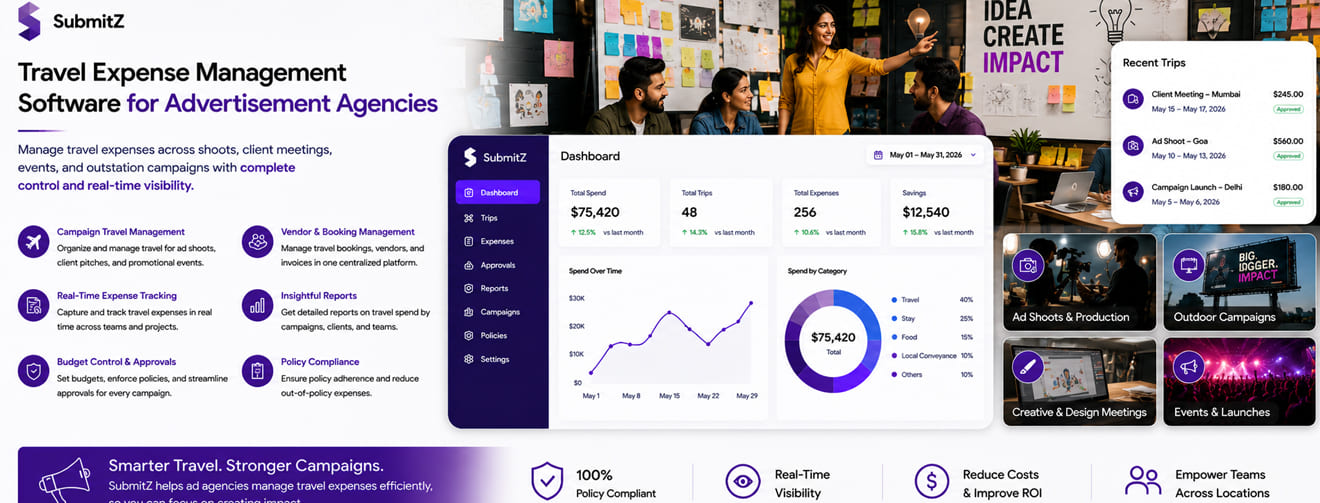
Advertisement agencies run on movement. Account managers fly out for client pitches, creative teams travel to shoot locations, production heads commute between studios and vendors, and business heads jump city to city to close new accounts. Travel isn't a side activity for an ad agency — it's part of how the business earns revenue.
Yet, ironically, most agencies still track this constant movement of money using spreadsheets, WhatsApp messages, paper bills stapled to expense sheets, and email approval chains. What looks like a "small back-office process" quietly becomes one of the biggest sources of financial leakage, team friction, and delayed decision-making in the agency.
This blog breaks down exactly where agencies bleed money and time without a proper system, and how a dedicated platform like SubmitZ solves it for every stakeholder — employees, owners, finance teams, and managers.
An account executive returning from a two-day shoot shouldn't have to spend another two hours collecting fuel bills, cab receipts, hotel invoices, and client entertainment slips, then manually filling an Excel sheet and mailing it to five people for sign-off. When reimbursements take weeks to process, employees end up funding company travel out of their own pocket for extended periods. This directly hurts morale, and in a talent-driven industry like advertising, frustrated employees don't stay long.
Agency owners are juggling multiple client accounts, each with its own budget and profitability expectations. Without real-time visibility into who spent what, on which client, and why, owners are forced to make decisions on outdated or incomplete information. By the time a monthly report is manually compiled, the budget overrun has already happened and the damage to that account's profitability is done.
Finance and accounts teams in agencies end up spending disproportionate hours matching physical receipts to claims, chasing employees for missing bills, manually checking for duplicate or inflated claims, and re-entering data into accounting software. This is manual, repetitive, error-prone work that pulls finance professionals away from actual financial planning, client billing accuracy, and cash flow management — the things that truly need their expertise.
Account and department heads often become an approval bottleneck simply because expense requests arrive through scattered emails, PDFs, and forwarded messages instead of one queue. This delays reimbursements further, and worse, managers often approve claims without a clear view of whether the spend was policy-compliant or budget-aligned, since they don't have consolidated data in front of them.
Without a system that enforces travel and expense policies automatically, it becomes very easy for inflated cab bills, personal expenses disguised as client meetings, or duplicate claims to slip through. Over a year, across dozens of employees and hundreds of trips, this "small leakage" adds up to a significant, avoidable loss.
Advertising agencies frequently need to bill certain travel and production expenses back to clients. When expenses aren't tagged, categorized, and tracked project-wise from day one, agencies either under-bill clients (a direct loss) or delay invoicing (a cash flow problem) because reconstructing which expense belonged to which client account takes days of manual digging.
During internal reviews, statutory audits, or client audits (common in retainer-based agency contracts), agencies are expected to produce a clean, traceable record of who approved what, and when. Paper trails and scattered emails simply don't hold up, exposing the agency to compliance risk and reputational damage with clients.
SubmitZ is an all-in-one, web and mobile-based travel, expense, claim and reimbursement management software built to remove exactly these pain points. It replaces manual paperwork with a fully automated, customizable workflow and adds a built-in CRM layer, making it especially relevant for client-facing, project-driven businesses like advertisement agencies.
Ad agencies operate differently from typical office-based businesses, which is exactly why generic financial processes fail them:
Every month an agency delays adopting a dedicated system, it continues to lose money to unbilled client expenses, unnoticed policy violations, and finance hours spent on manual reconciliation instead of strategic work. It also continues to lose employee trust and time to a reimbursement process that feels outdated compared to the tools they use everywhere else in their lives.
A travel, expense, claim and reimbursement management platform like SubmitZ isn't an added expense for an advertisement agency — it's a direct protection of agency margins, client trust, employee satisfaction, and financial compliance, all built into one customizable, multi-lingual, multi-currency system that works on web and mobile.
For an industry that is defined by movement, deadlines, and client relationships, treating travel expense management as an afterthought is a costly mistake. From the employee filing a claim, to the manager approving it, to the finance team reconciling it, to the owner reading the final numbers — every stakeholder in an advertisement agency benefits when this process is automated, transparent, and policy-driven.
SubmitZ brings all of this together in one platform, purpose-built to replace laborious paperwork with an intelligent, automated workflow — helping agencies protect their margins while giving their people a faster, fairer, and far more transparent experience.