
Get in Touch
-
Phone
+91 93115 81081
-
Email Now
hi@submitz.com
-
Delhi, India
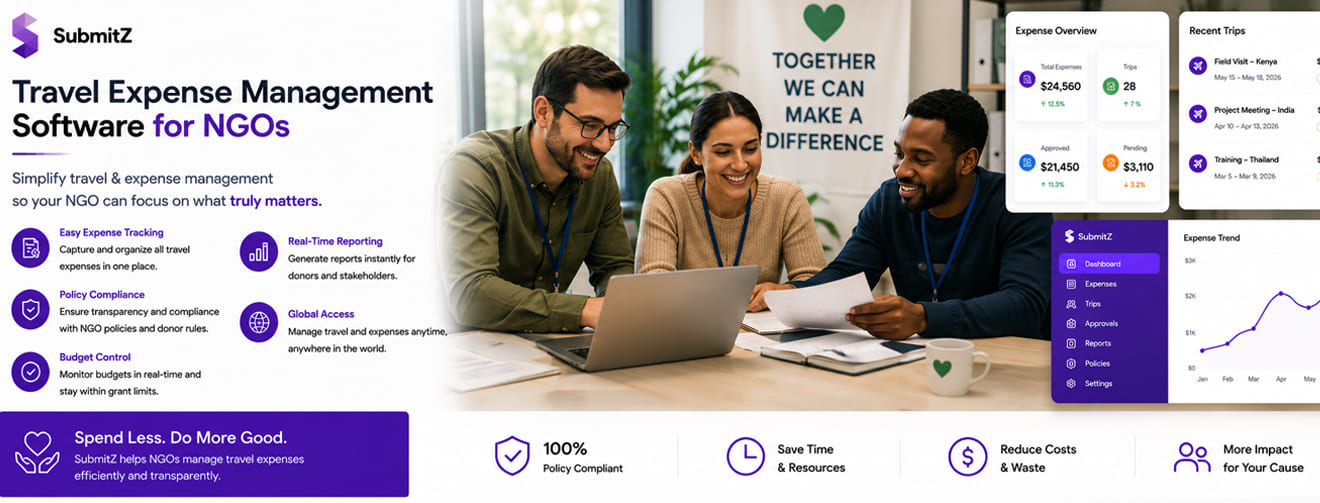
NGOs need dedicated travel expense management software because manual, spreadsheet-based tracking creates compliance risk with grant restrictions, delays field staff reimbursements, invites fraud and errors, and gives finance teams almost no real-time visibility into program spending. Purpose-built platforms like SubmitZ automate receipt capture, policy enforcement, multi-currency conversion, and grant-wise reporting — turning a slow, error-prone process into a transparent, audit-ready one that protects donor trust.
Ask any finance officer at a nonprofit how travel expenses get tracked, and you'll likely hear some version of the same story: a shared spreadsheet, a folder of scanned receipts, WhatsApp messages from field staff asking "did my claim get approved?", and a month-end scramble to reconcile everything before a donor report is due.
For a small team, this might be manageable. But most NGOs don't operate like small teams — they operate like distributed, multi-project, multi-currency organizations with dozens (sometimes hundreds) of field staff, volunteers, and consultants traveling constantly between program sites, training locations, and disaster response zones. Layer on strict grant compliance rules, tight budgets, and donor audits, and manual expense tracking stops being an inconvenience — it becomes an organizational risk.
This is exactly why travel expense management software has moved from a "nice-to-have" for corporations to a mission-critical tool for NGOs. In this guide, we break down the specific pain points nonprofits face, why generic expense tools often fall short, and how a platform like SubmitZ is built to solve these problems.
Unlike a typical business, NGO spending isn't just "company money." It's donor money, grant money, and public trust — all rolled into one. That changes the stakes considerably:
These structural differences mean that generic corporate expense tools — designed around simple "submit and reimburse" workflows — often miss what NGOs actually need: grant-level tracking, multi-project allocation, and donor-ready reporting.
Field staff returning from a project visit often spend hours compiling receipts, filling out expense sheets, and emailing them to headquarters. Multiply that by dozens of employees and volunteers across multiple projects, and you have a significant chunk of staff hours diverted away from actual program delivery — hours that should be spent on the mission, not paperwork.
Many NGOs rely on staff and volunteers to pay out-of-pocket for travel and then wait — sometimes for weeks — to be reimbursed. For lower-paid field workers or volunteers, this delay isn't just an inconvenience; it's a genuine financial burden. Slow reimbursement cycles are a quiet but real driver of staff dissatisfaction and turnover in the sector.
When expenses live in scattered spreadsheets and email threads, program managers have no real-time way to know how much of a grant's travel budget has already been used. This makes it nearly impossible to course-correct mid-project, and it increases the risk of overspending — or worse, underspending funds meant for direct program impact.
Grants come with strings attached: specific allowable expense categories, per diem caps, geographic restrictions, and reporting formats. Manually checking every travel claim against a maze of donor-specific rules is tedious and error-prone — and a single non-compliant expense can put an entire grant tranche, or the relationship with that donor, at risk.
Without automated checks, it's easy for duplicate receipts, inflated mileage claims, or out-of-policy purchases to slip through — not necessarily out of malice, but simply because no one has time to cross-check every submission. Even small, repeated leakages add up to real money diverted from program impact.
International NGOs and those working across multiple countries deal with different currencies, exchange rate fluctuations, and local tax rules. Manually converting and reconciling these is time-consuming and a common source of reporting errors.
When donors or auditors request a full expense trail for a project, teams relying on spreadsheets and paper receipts often spend days (sometimes weeks) hunting down missing documentation. This reactive scramble damages credibility and consumes bandwidth that could go toward programs.
NGOs frequently bring on volunteers or short-term consultants for specific projects. Training every new person on a clunky expense process — and manually setting up and tearing down their access — adds administrative overhead that a permanent staff-focused tool doesn't account for.
Given these pain points, the right software for a nonprofit should offer:
SubmitZ is built around the reality that NGOs and their field teams need a travel expense management platform that's fast, transparent, and accountable — without adding administrative burden. Here's how it addresses the pain points above:
Field staff and volunteers can capture receipts and submit travel claims directly from their phones, even while on the move between project sites — removing the end-of-trip paperwork pile-up entirely.
By automating the approval chain and flagging complete, policy-compliant claims for fast processing, SubmitZ helps get money back into the hands of staff and volunteers faster, improving morale and retention.
Every expense can be tagged to a specific grant, program, or fund, giving finance teams and program managers a real-time picture of how travel budgets are tracking against donor allocations — before overspending becomes a problem.
Automated rule enforcement means claims that fall outside a donor's allowable expense categories, per diem limits, or documentation requirements are flagged immediately — reducing compliance risk and protecting funding relationships.
By automatically checking incoming claims for duplicates and inconsistencies, SubmitZ reduces the quiet financial leakage that manual review often misses.
For NGOs operating across borders, SubmitZ handles currency conversion and localized reporting automatically, removing a major source of reconciliation headaches.
Because every claim, receipt, and approval lives in one system with a clear trail, SubmitZ turns donor audits and grant reporting from a scramble into a straightforward export.
SubmitZ is built to be intuitive enough that volunteers and short-term staff can start submitting expenses correctly from day one — without lengthy training — while giving finance teams the control and reporting depth they need.
Every hour a program manager spends chasing receipts, and every rupee lost to a duplicate or non-compliant claim, is time and money not spent on the people an NGO exists to serve. Donors are increasingly scrutinizing operational efficiency alongside program impact — and organizations that can demonstrate tight, transparent financial controls build stronger, longer-lasting funding relationships.
Investing in travel expense management software isn't an administrative luxury for NGOs. It's a direct investment in credibility, staff wellbeing, and mission impact.
Spreadsheets don't scale with multiple grants, currencies, and distributed field staff. They lack real-time visibility, automated compliance checks, and audit trails — all of which donors and auditors increasingly expect.
Yes. Modern platforms like SubmitZ are designed with flexible, budget-conscious pricing in mind, recognizing that nonprofits need enterprise-grade control without enterprise-level costs.
It automatically tags expenses to the correct grant or fund, checks claims against donor-specific policies, and generates audit-ready reports — reducing the risk of non-compliant spending.
Yes. Platforms like SubmitZ are built to be simple enough for occasional users, like volunteers or short-term consultants, to submit accurate claims without extensive training.
Yes. SubmitZ supports multi-currency expense submission and conversion, making it suitable for international NGOs and cross-border program teams.
Ready to give your field teams and finance staff a simpler, more transparent way to manage travel expenses? See how SubmitZ can help your NGO save time, protect donor trust, and put more resources back into your mission.