
Get in Touch
-
Phone
+91 93115 81081
-
Email Now
hi@submitz.com
-
Delhi, India
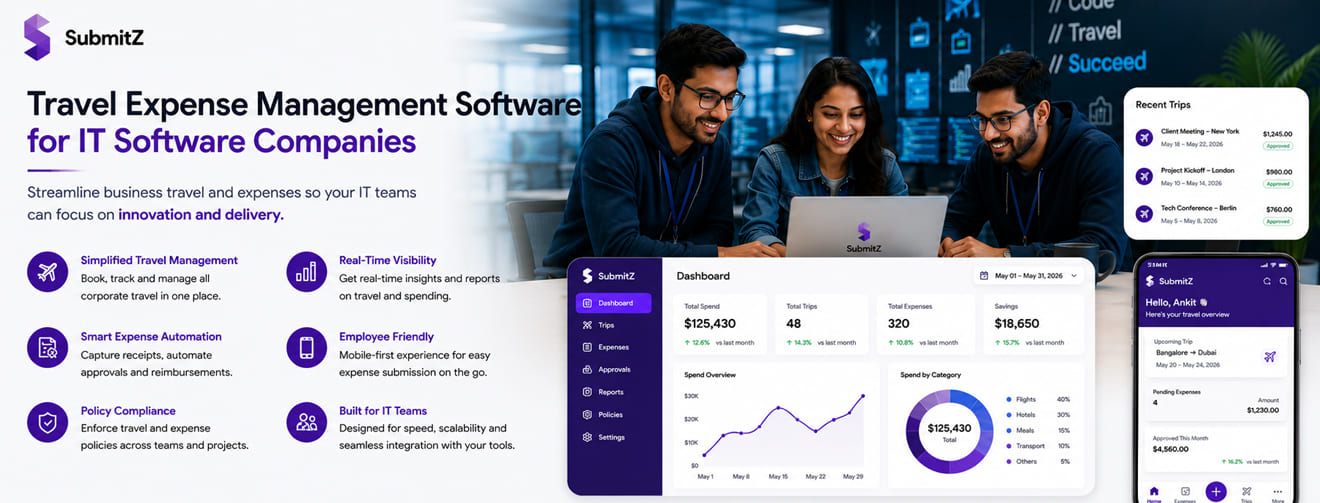
IT companies need dedicated travel expense management software because manual tracking across client-billable trips, global delivery teams, and multi-project engagements creates billing errors, delayed reimbursements, and poor visibility into project margins. Purpose-built platforms like SubmitZ automate receipt capture, client and project tagging, multi-currency handling, and policy enforcement — helping IT firms protect margins, speed up billing cycles, and keep consultants focused on delivery instead of paperwork.
IT companies run on travel. Consultants fly out for client onboarding, engineers visit data centers for deployments, sales teams attend conferences, and delivery leads shuttle between client sites for reviews. Add remote and hybrid delivery models, offshore-onshore team structures, and a workforce that's constantly moving between projects, and travel expense tracking becomes one of the most operationally complex parts of running an IT business.
Yet many IT companies — from fast-growing startups to established consulting and services firms — still manage this with spreadsheets, email approvals, and manual reconciliation against client contracts. It works, until it doesn't. As headcount grows and the number of active client engagements multiplies, manual expense management quietly starts costing the business real money: through billing leakage, reimbursement delays, and finance teams drowning in reconciliation work at month-end close.
This is why travel expense management software has become essential infrastructure for IT companies, not just a back-office nice-to-have. In this guide, we cover the specific pain points IT firms face and how a platform like SubmitZ is built to solve them.
IT companies aren't just managing employee reimbursements — they're managing money that's often tied directly to client contracts and project profitability. A few things make this industry distinct:
Generic, one-size-fits-all expense tools often don't account for this project-and-client-centric reality, leaving IT firms to bolt together spreadsheets and manual approvals just to get accurate client billing.
When consultant travel expenses aren't cleanly tagged to the right client and project from the start, firms either forget to bill clients for legitimate costs (a direct margin loss) or bill the wrong client entirely, damaging trust. Untracked billable expenses are one of the quietest but most expensive leaks in IT services businesses.
Employees who front travel costs for client visits and then wait weeks for reimbursement quickly grow frustrated — especially in a competitive talent market where consultants have other options. Slow, manual approval chains are a real, if underappreciated, driver of attrition risk.
Without live expense data tied to specific projects, delivery leads and finance teams can't tell whether a client engagement is on budget until the month is already closed — by which point it's too late to course-correct. This makes accurate, timely project margin tracking nearly impossible with manual systems.
Many IT companies use separate systems for booking travel and for reporting expenses, forcing employees and finance teams to reconcile data across disconnected platforms. This fragmentation creates data gaps, duplicate entry, and more room for errors and fraud to slip through.
An IT company with delivery centers in multiple countries has to manage different per diem rates, tax rules, and expense categories for each geography. Manually enforcing this patchwork of policies is time-consuming and error-prone, and inconsistent enforcement creates both compliance risk and employee frustration over "unfair" rule application.
Consultants traveling between countries submit receipts in multiple currencies, and converting, verifying, and reconciling these manually eats up significant finance team bandwidth every month — time that could go toward higher-value financial analysis.
When expense reports trickle in late, incomplete, or without proper client/project coding, finance teams scramble to chase down documentation before close. This delays not just internal reporting but also client invoicing, which directly impacts cash flow.
As headcount grows, so does the volume of expense claims — and without automated checks, duplicate submissions, inflated mileage, or out-of-policy purchases become harder to catch manually, quietly eating into already-thin project margins.
Given these pain points, the right software for an IT company should offer:
SubmitZ is built for the reality of IT services businesses: multiple clients, multiple projects, distributed teams, and margins that depend on accurate, timely expense tracking. Here's how it addresses the pain points above:
Every expense can be tagged to the correct client and project at the point of submission, so billable travel costs are captured correctly the first time — protecting margins and speeding up client invoicing.
By automating approval routing and flagging complete, policy-compliant claims for quick processing, SubmitZ helps employees get reimbursed faster, improving satisfaction and reducing attrition risk among travel-heavy roles.
Delivery leads and finance teams get live dashboards showing travel spend against project budgets, making it possible to catch and correct overspending before it erodes margins — instead of discovering it at month-end.
SubmitZ brings travel and expense data together in a single platform, eliminating the reconciliation headaches and data gaps caused by using separate booking and reporting tools.
Configurable, location-aware policy rules mean per diem limits, allowable categories, and tax handling are automatically enforced correctly for every team, in every country — without finance manually cross-checking each claim.
SubmitZ automatically handles currency conversion and localized reporting, removing a major source of reconciliation delay for globally distributed delivery teams.
With complete, properly coded expense data flowing in throughout the month rather than arriving in a last-minute rush, finance teams can close the books and issue client invoices faster.
Automated checks flag duplicate claims and policy violations as they're submitted, helping IT firms catch leakage at scale as headcount and travel volume grow.
In IT services, margin is won or lost in the details — and travel expenses that go untracked, unbilled, or unreconciled quietly chip away at profitability on every client engagement. As firms scale across more clients, more projects, and more geographies, manual expense processes stop being a minor inefficiency and start becoming a real constraint on growth.
Investing in travel expense management software isn't just about saving finance team hours. It's about protecting project margins, speeding up client billing, and keeping talent satisfied in a competitive market.
Spreadsheets don't scale across multiple clients, projects, and currencies. They lack real-time visibility, automated billing tags, and policy enforcement — all of which growing IT firms need to protect margins and bill clients accurately.
By tagging every expense to the correct client and project at submission, platforms like SubmitZ ensure billable travel costs are captured accurately and can be invoiced to clients without manual cross-checking.
Yes. SubmitZ supports multi-currency submission and conversion, along with geography-specific policy rules, making it suitable for IT companies with offshore-onshore or multi-country delivery models.
Yes. Real-time dashboards tied to project-level expense data let delivery leads and finance teams monitor spend against budget as it happens, rather than discovering overruns after month-end close.
Yes. SubmitZ is designed to scale from lean, fast-growing IT teams to larger, multi-project consulting and services organizations, with configurable workflows that adapt as the business grows.
Ready to stop losing margin to untracked travel expenses and slow reimbursements? See how SubmitZ can help your IT company bill clients accurately, speed up approvals, and give finance and delivery teams real-time visibility into project spend.