
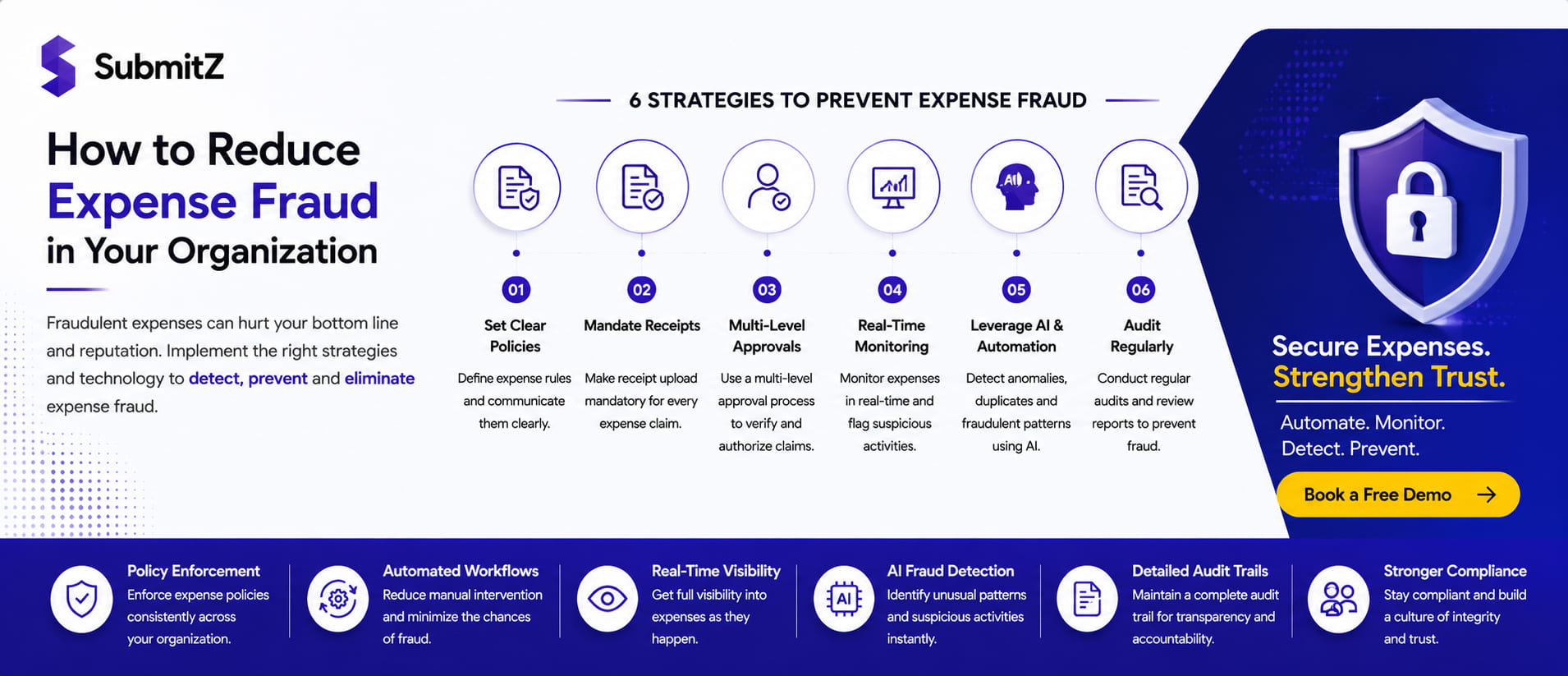
How to Reduce Expense Fraud in Your Organization
Expense fraud rarely looks dramatic. It's not a single big theft that sets off alarm bells, it's a slightly inflated mileage claim here, a duplicate bill there, a personal dinner quietly logged as a "client meeting" somewhere else. Individually, these look small. Collectively, across an entire workforce and over a full year, they can quietly cost a business a significant amount of money, and most organizations only discover the scale of it during an audit.
This blog looks at the most common forms of expense fraud, why manual processes make it so easy to miss, and the practical steps organizations can take to reduce it, including how SubmitZ, an all-in-one travel, expense, and reimbursement management software, builds fraud prevention directly into the expense workflow.
Common Types of Expense Fraud
1. Duplicate Claims
The same receipt or expense is submitted more than once, sometimes across different reporting periods, hoping no one cross-checks previous submissions.
2. Inflated Mileage Claims
Without a verifiable tracking method, employees may round up or overstate travel distances, and over time, these small inflations add up across an entire team.
3. Fake or Altered Receipts
Receipts can be edited, recreated, or entirely fabricated when there's no digital verification step in place to confirm authenticity.
4. Personal Expenses Disguised as Business Expenses
Personal meals, gifts, or purchases get logged under vague or misleading categories to slip past approval without questions.
5. Policy Violations That Go Unchecked
Claims that exceed approved limits or fall outside policy categories get approved anyway, simply because no one is manually cross-referencing every submission against the rulebook.
6. Advance Misuse
Cash or bank advances issued before a trip are not properly reconciled against actual spending, leaving gaps that are easy to exploit and difficult to trace later.
Why Manual Processes Make Fraud Easy
Manual expense management relies heavily on trust and spot-checking. Finance teams cannot realistically review every single receipt, cross-check every mileage claim, or manually verify every category against policy when claims are coming in through email, paper forms, and spreadsheets. Fraud isn't necessarily common because employees are dishonest, it's common because the system makes it easy and the odds of detection are low.
Practical Steps to Reduce Expense Fraud
1. Digitize Receipt Submission
Require employees to scan or photograph receipts directly at the point of spending, and store them digitally against each claim. This removes the ability to recreate, alter, or reuse receipts later.
2. Automate Policy Enforcement
Build spending limits, approved categories, and claim rules directly into the system so that violations are automatically flagged before a claim is approved, not discovered after the money is already gone.
3. Use GPS-Based Mileage Tracking
Replace self-reported mileage with GPS-enabled tracking that captures actual travel distances, removing the opportunity to inflate claims.
4. Set Up Multi-Level, Role-Based Approvals
Route claims through structured approval chains based on amount, department, or category, so that no single person can approve their own or a colleague's inflated claim without oversight.
5. Maintain a Complete Audit Trail
Every submission, approval, rejection, and edit should be automatically logged. A visible, timestamped audit trail discourages fraud simply because employees know every action is tracked and traceable.
6. Automatically Reconcile Advances Against Claims
Map every cash or bank advance directly against the employee's actual submitted expenses so that unused or unaccounted amounts are immediately visible instead of quietly disappearing.
7. Give Managers Real-Time Visibility
Live dashboards and reports let managers and finance leaders spot unusual spending patterns as they happen, rather than during a once-a-year audit when the damage is already done.
How SubmitZ Builds Fraud Prevention Into the Process
SubmitZ is designed to make fraud and wasteful spending far harder to hide, not through a single feature, but by embedding checks throughout the entire expense lifecycle:
- Transparent Process — SubmitZ is built to help companies verify any policy violation, fraud, or wasteful expense recorded, rather than leaving detection to chance.
- Custom Policies — spending rules and approved categories are configured into the system so violations are flagged automatically rather than discovered after payment.
- Custom Approvals — role-based, multi-level approval workflows ensure claims are reviewed by the right people, removing single points of failure.
- Receipt Management — employees scan and manage bills digitally, closing the gap that allows recreated or duplicate receipts to pass through.
- Mileage Tracking — GPS-enabled tracking captures accurate, verifiable travel distances instead of relying on estimates.
- Advance Management — cash and bank advances are automatically mapped and tracked against actual expenses, closing reconciliation gaps.
- Audit Trail — every transaction and approval is automatically logged, creating a complete, audit-ready record at all times.
- Reports and Analytics — real-time dashboards give business owners, CEOs, HODs, and administrators instant visibility into spending trends, making unusual patterns easy to spot.
- No Manual Intervention — the entire expense and reimbursement process runs smoothly and automatically, reducing the human gaps where fraud typically slips through.
Because SubmitZ is highly customizable, these controls can be configured to match the specific policies and risk areas of different industries, including manufacturing, trading, consulting, real estate, education, NGOs, and service sector businesses.
The Bottom Line
Expense fraud thrives in manual, loosely monitored systems where policy checks depend on human memory and spot-checking. Reducing it isn't about distrusting employees, it's about removing the blind spots that make dishonest claims easy to submit and hard to catch. By digitizing receipts, automating policy checks, enforcing structured approvals, and maintaining a complete audit trail, organizations can close most of the gaps fraud relies on.
SubmitZ brings all of these controls together in one connected, customizable platform, turning expense management from a trust-based, error-prone process into a transparent, policy-driven system that protects company budgets at every step.