
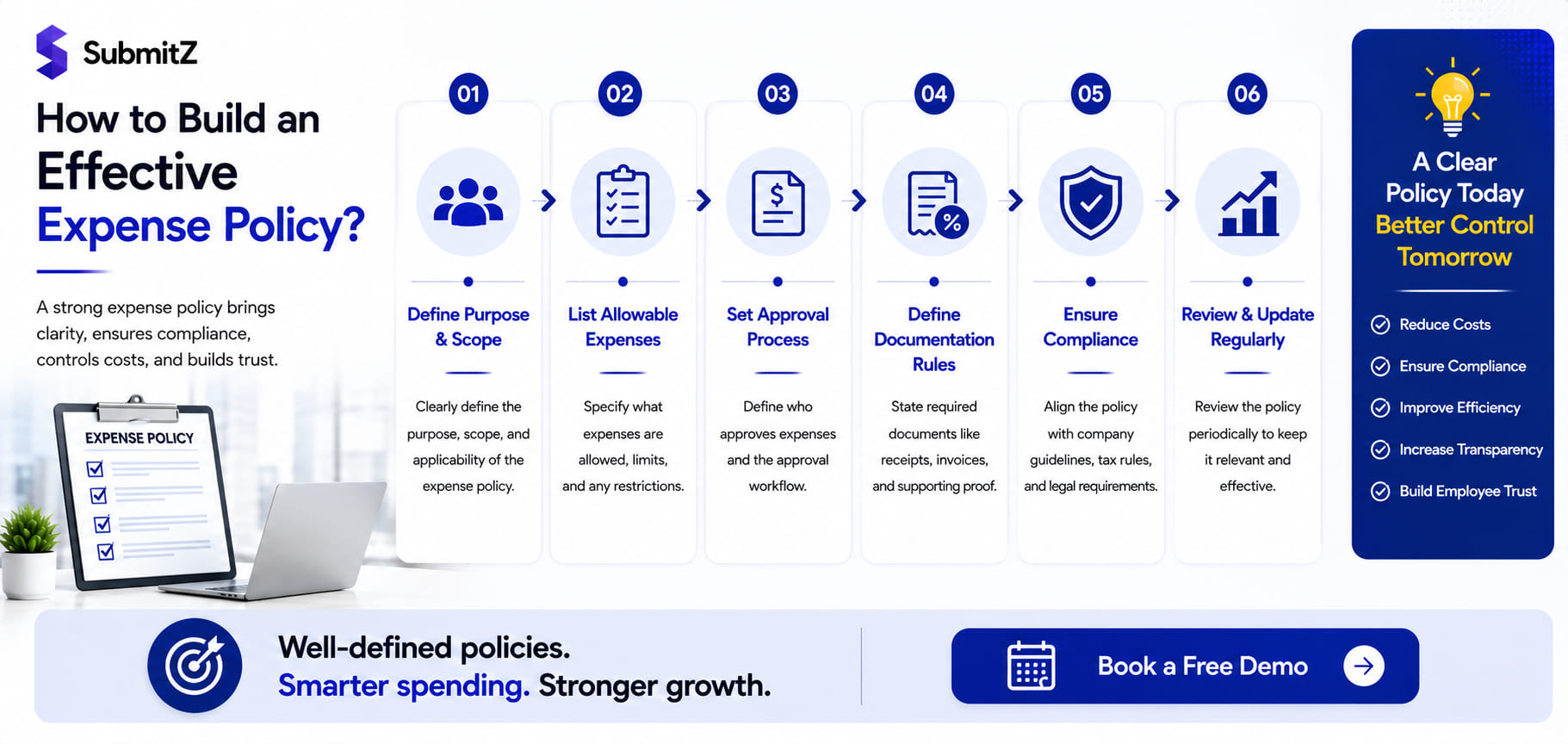
How to Build an Effective Expense Policy
Most businesses have an expense policy in some form, a paragraph in the employee handbook, a verbal understanding, or a rule someone mentioned once in a meeting. The problem is that a policy nobody can find, nobody fully remembers, and nobody enforces consistently isn't really a policy at all. It's a guideline that only works until someone tests its limits.
An effective expense policy needs to be clear, specific, easy to reference, and, ideally, built directly into the systems employees use to submit claims. This blog walks through how to build one from the ground up, and how SubmitZ, an all-in-one travel, expense, and reimbursement management software, helps turn a written policy into something that's actually enforced.
Step 1: Define the Purpose and Scope
Start by being clear about what the policy covers: business travel, client entertainment, office supplies, per diem allowances, mileage, and any other spending categories relevant to your business. A policy that's vague about scope leaves employees guessing, which is exactly where inconsistent claims start.
Step 2: Set Clear Spending Limits by Category
Instead of one blanket rule, break spending limits down by category, meals, accommodation, local travel, client entertainment, so employees know exactly what's reasonable in each situation. Specific numbers remove ambiguity far better than general language like "reasonable expenses."
Step 3: Define Approved and Non-Approved Expense Categories
List out clearly what counts as a reimbursable business expense and what doesn't. Ambiguity here is one of the biggest sources of disputes and, sometimes, misuse. If personal expenses, alcohol, or upgrades are excluded, say so explicitly rather than leaving it open to interpretation.
Step 4: Establish Documentation Requirements
Specify what proof is required for a claim to be valid, typically an itemized receipt, and at what value threshold documentation becomes mandatory. This protects the business during audits and sets a clear expectation for employees from day one.
Step 5: Standardize Mileage and Per Diem Rules
Rather than letting mileage and daily allowance claims vary from person to person, set a fixed rate per kilometer or mile, and clear per diem amounts based on location or role. Consistency here prevents both confusion and the small inflations that add up over time.
Step 6: Define the Approval Workflow
Spell out who approves what, based on amount, department, or category, and what happens if an approver is unavailable. A policy without a defined workflow tends to collapse into ad hoc approvals, which is where delays and inconsistency creep in.
Step 7: Set Clear Timelines
Define how quickly employees must submit claims after spending occurs, and how quickly finance is expected to process approved reimbursements. Timelines on both sides keep the process moving and prevent expenses from piling up unsubmitted for months.
Step 8: Address Cash Advances
If your business issues advances before travel, the policy should clearly state how advances are requested, how they must be reconciled against actual spending, and what happens with any unused balance.
Step 9: Build in Consequences for Policy Violations
A policy without consequences is more of a suggestion. Be clear about what happens when a claim violates policy, whether that's rejection, a request for clarification, or escalation, so enforcement is predictable and fair across the organization.
Step 10: Make the Policy Easy to Access and Understand
A policy buried in a PDF nobody opens might as well not exist. Make it easily accessible, written in plain language, and ideally visible at the exact moment an employee is submitting a claim, not just filed away in an onboarding document.
Step 11: Automate the Policy, Don't Just Document It
The most effective expense policies aren't just written, they're built directly into the tools employees use every day, so enforcement doesn't depend on memory or manual review. This is where most manual expense processes fall short, even a well-written policy is only as strong as its enforcement.
How SubmitZ Turns Policy Into Practice
SubmitZ is built specifically to take an expense policy from a written document to an automatically enforced system. Here's how each part of policy design connects directly to a SubmitZ feature:
- Custom Policies — spending limits, approved categories, and documentation rules are configured directly into the system, so violations are automatically flagged before a claim is approved.
- Custom Approvals — role-based, multi-level approval workflows route claims to the correct approver automatically, exactly as defined in your policy.
- Mileage Tracking — GPS-enabled tracking applies your standardized mileage rate consistently, removing manual estimation.
- Per Diem Management — daily allowance rules are automated based on policy, ensuring every employee is reimbursed consistently.
- Advance Management — cash and bank advances are tracked and automatically reconciled against actual claims, exactly as your policy requires.
- Receipt Management — documentation requirements are enforced digitally, with bills scanned and stored against each claim.
- Budgeting — spending limits can be set in advance for trips or departments, giving your policy a proactive, not just reactive, layer of control.
- Audit Trail — every submission, approval, and policy check is automatically logged, giving you a clear record of how consistently the policy is being applied.
- Reports and Analytics — real-time dashboards let business owners and finance leaders see how spending aligns with policy across the organization.
SubmitZ is also highly customizable across industries, manufacturing, trading, consulting, real estate, education, NGOs, and services, so your policy can reflect exactly how your business operates rather than forcing a generic set of rules onto your team. It also supports multi-lingual and multi-currency use, ensuring policy clarity for diverse and distributed workforces.
The Bottom Line
An effective expense policy is specific, accessible, and consistently enforced, not a document that sits unread until a dispute forces someone to dig it up. Writing a clear policy is the first step, but the real difference comes from building that policy directly into the systems employees use every day. SubmitZ lets businesses do exactly that, turning a written expense policy into an automated, consistently enforced part of the expense management workflow.